Spider Solitaire
About Spider Solitaire
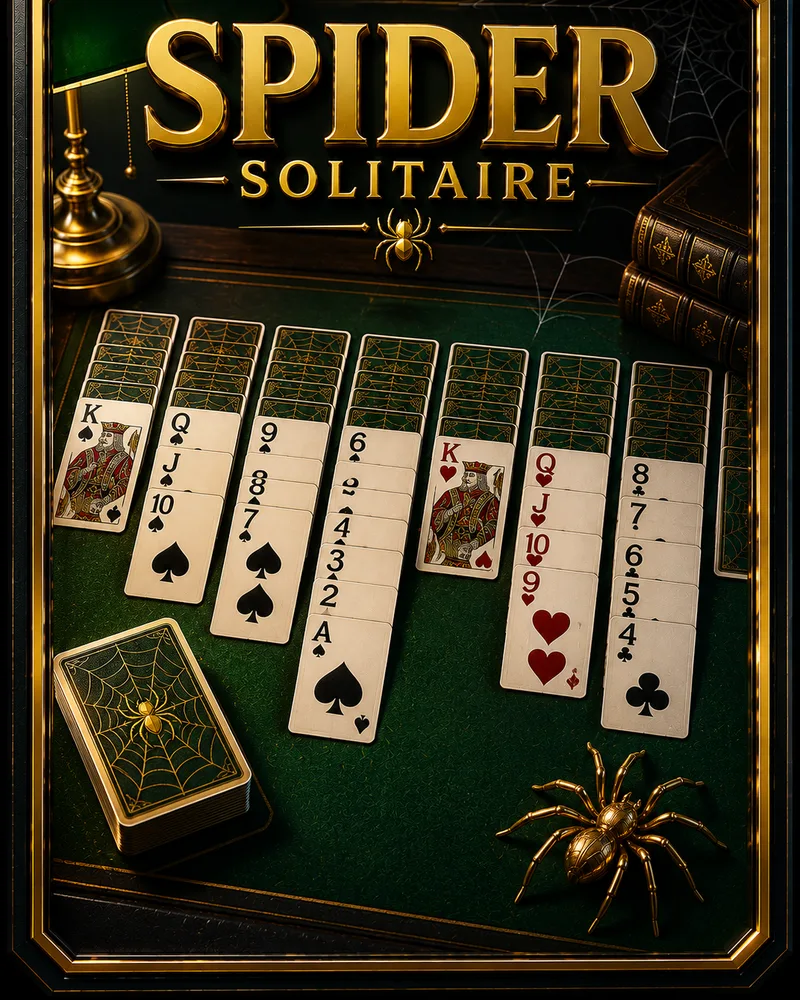
Spider Solitaire is a bigger, tougher cousin of the classic card game. You play with two full decks spread across ten columns, and your goal is to build complete runs from king down to ace and clear them off the table. Do that eight times and you win.
It earned its reputation as the solitaire for people who find the standard version too gentle. One careless move can lock up a column and stall the whole board, so it rewards looking ahead. Windows made it famous by bundling it for years, but the game itself is older and less forgiving than its cheerful cousin.
You can play Spider free in your browser with no download. If it is your first try, start on the one-suit version, where any card can stack on any other, and work your way up as it clicks. It takes a few games to get a feel for it, but that difficulty is exactly why finishing one feels so good.
Controls
You play by tapping or clicking cards between the ten columns, not dragging them. Tap a card, or a run of cards, to select it, then tap the column you want it to join. The game only allows legal moves, so it will stop you from making an impossible one.
A few rules give Spider its particular bite:
- Building down means placing cards in descending order. Any card can go on a card one rank higher, regardless of suit, so a mixed pile is fine while you organize.
- Moving runs only works when the cards are the same suit and in order. That is the catch: a tidy same-suit sequence travels together, but a mixed one does not.
- The stock deals a new card onto every column at once. You can only use it when no column is empty, so you have to plan around it.
You clear a suit by building a full run from king down to ace in one suit, which then lifts off the board. Clear all eight to win.
The difficulty rises across eight levels, which lines up naturally with playing more suits, from one forgiving suit up to the full four. A Help button spells out the rules, and Hint highlights the strongest legal move it can find if you're stuck.
Tips
- Empty a column whenever you can. An empty column is the most powerful thing in Spider, since it can hold any card and gives you room to untangle piles you would otherwise be stuck with.
- Build in a single suit when you have the choice. Cards of the same suit move as a group, so keeping a run in one suit means you can relocate the whole sequence later instead of one card at a time.
- Uncover face-down cards early. Hidden cards are locked options. Freeing them turns up new moves, so prioritize plays that flip a face-down card.
- Think before you deal from the stock. A new row lands on every column and can bury your neat sequences, so clear as many moves as you can and tidy up before dealing.
- Don't rush to fill an empty column. That space is valuable. Use it to reorganize suits or dig out a buried card rather than dropping the first card that comes along into it.
- Plan a few moves ahead. Spider punishes moves made in isolation. Picturing where a card sequence needs to end up before you start shuffling cards keeps the board from locking.
Frequently asked questions
Is Spider Solitaire free to play?
Yes. You can play as many games as you want with no download and no account.
How do you play Spider Solitaire?
You arrange two decks across ten columns, building cards downward in rank. When you complete a full run from king to ace in a single suit, it clears off the board, and clearing all eight runs wins the game.
Why can't I move a group of cards?
In Spider, only cards of the same suit in sequence move together. A run with mixed suits has to be moved one card at a time, which is one of the things that makes the game challenging.
Is Spider harder than regular solitaire?
Generally yes, especially with more suits in play. Starting on the one-suit version keeps it approachable, and moving up to two and four suits raises the difficulty as you improve.
Can I play Spider Solitaire on my phone?
Yes. It runs in any modern mobile browser, and you move cards by tapping rather than dragging, so it works well on phones and tablets.
How do I get better at Spider?
Focus on emptying a column, keep runs in a single suit, and uncover hidden cards before dealing new ones. Planning a few moves ahead is what keeps the board from locking up.
More like this



Popular right now 🔥
All →
Klondike Solitaire

Sudoku

2048

Chess

Ludo

Snake
Block Puzzle
Minesweeper

Checkers
Mahjong Solitaire

Snakes & Ladders

Word Search

Connect Four

Brick Breaker

Tic-Tac-Toe

Bubble Shooter

Match 3